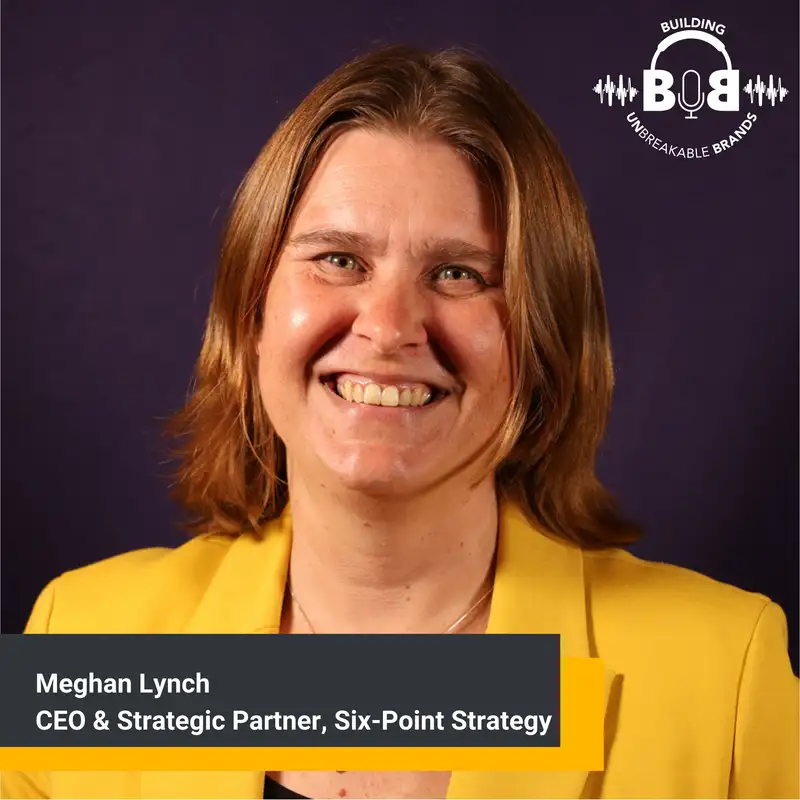
What I Saw This Year Inside Generational Businesses
[00:00] Meghan Lynch
I spent this past year inside generational businesses, in boardrooms, farm offices, factories, and plenty of Zoom rooms. And I saw something surprising. Amid all the noise, and all the change that everyone is feeling, two deeper forces kept showing up beneath it all.
Identity and intention.
Who are we, really?
And what are we choosing to create on purpose?
We’ll talk about why the companies that found clarity this year aren’t the burned‑out teams working the hardest. They were the ones willing to pause long enough to answer those two questions honestly.
So this special year‑end episode of Building Unbreakable Brands, I’ll be taking you through what I saw this year through this dual lens of identity and intention — the anchor and steering wheel of every lasting generational brand.
[01:05] Meghan Lynch
Welcome to Building Unbreakable Brands, the podcast for leaders with a generational mindset.
I’m Meghan Lynch, advisor to generational businesses and CEO of Six‑Point Strategy. Today is a special year‑end solo episode, so I’ll invite you to be my guest and reflect along with me. Let’s get started.
If I had to choose one theme that shaped this year more than any other, it would be identity. Identity isn’t just a marketing exercise. I would say it’s the bedrock foundation of a generational business. And this year, I saw identity questions showing up everywhere.
[01:45] Meghan Lynch
Sometimes it sounded like adolescence — we’re not who we were, but we’re not yet who we’re becoming. Other times it sounded like disruption — our customers are changing, and we’re not sure what that means for us. Or it even sometimes sounded like succession — our next generation is stepping in, but what are they stepping into exactly? That in‑between space can be really uncomfortable, but it’s also a sign of growth. And the companies that handled it well didn’t rush to fill the discomfort. They got curious.
[02:30] Meghan Lynch
Let me share one moment that really stayed with me. This fall, I was with a second‑generation company preparing for a leadership transition to the third generation. They were so proud of their history, and had actually taken pieces of it — like photos and headlines and artifacts — and used them to decorate the walls of the office. But the current CEO admitted that every single time he walked through the halls, he felt pressure to keep the status quo and avoid any kind of big, bold evolutionary moves, even while the industry was experiencing a ton of rapid consolidation.
He said that he felt like he was in one of those James Bond movies, with the walls closing in on both sides, and a timer running out.
[03:15] Meghan Lynch
And here’s what changed everything. Instead of treating the past like a museum, he brought his team together and asked a different question: What part of this legacy is still alive and growing in us today?
All of a sudden, you could feel the room shift. Suddenly, they were owning an identity that was simultaneously solid and very real, while also alive and evolving.
Identity is not about protecting the past. It’s about understanding who you are now, and what makes that possible.
[04:00] Meghan Lynch
I also think back to my conversation with Ann Bauer, when she recounted the phone call she got from her dad during COVID — reminding her that the company had not always done the same thing, and didn’t always have to do the same thing in the future. If you haven’t listened to that episode, you need to — because the power and impact of that identity shift on her still gives me chills
There’s something else I was reminded of this year, too. Teams that were frustrated and exhausted often weren’t dealing with communication problems. They were dealing with identity problems. Because when a leader can’t articulate the company’s vision in one clear sentence, the team can’t follow it. When identity is fuzzy, everything just feels harder. On the other hand, when identity is clear, teams rally. Decision‑making gets easier. Succession gets calmer. Strategy becomes real on the front lines.
[05:00] Meghan Lynch
Again, I think of my conversations with Mark Moffitt and Toby Flowers, and how, when they got clear on their identity, all of their strategic and tactical decisions just had a different kind of energy. So, as my guest today, here’s a question we’re sitting with: Part of your company’s identity feels unsettled right now — and why? Usually that’s where its next phase is going to begin. And if identity answers the question who are we?, intention answers how will we lead?
And this year made it so clear that identity and intention are not the same thing.
[06:00] Meghan Lynch
I was talking with another advisor the other day, and she was describing a recurring pattern she was seeing of leaders who saw very clearly big, important things that needed to get done. So they were piling change on their teams, who were, in turn, running really hard to keep up and getting burned out in the process. We’ve talked about the difference between speed and intention. One phrase that a colleague at Six‑Point always repeats to me is: slow is smooth, smooth is fast. That kind of intentional slowing down — ensuring that everyone is on the same page, that the pace, order, and next steps are thoughtful — is absolutely critical.
[06:45] Meghan Lynch
I was talking with a father and son in the midst of succession planning, and one of the intentional moves they made was to set a date for the dad to be away from the business for a year on sabbatical, and to talk about that publicly and often for accountability — because he knew he would potentially backslide otherwise. This was his way to honor his commitment to his family and his team. That kind of intentionality is the difference between simply working hard at something and being truly successful.
[07:30] Meghan Lynch
I’ve seen the same intentionality on the growth and customer side of generational businesses. This year, customer behavior changed faster than teams expected, especially in long‑standing relationships. The companies that stayed ahead weren’t the ones who relied on assumptions. They were the ones who listened — intentionally and consistently. They asked new questions. They revisited old beliefs. They treated customer insight as a rhythm. Almost all of them said the same thing afterwards: I wish we had done this sooner.
[08:15] Meghan Lynch
I think back to my conversation with Deanne Peterson about encouraging sales leaders to carefully balance instinct with intention. Or my conversation with Andrea Carpenter, who reminded us that succession is not an event — it’s a process. This is true with any kind of change. Change is not one event. It’s a process, and a rhythm. And intention is what sets the tempo. Here’s a question for you: Where are you reacting? And where could some intentional slowing down actually help you move further and faster in the long run? That single distinction changes everything.
[09:00] Meghan Lynch
As I look back on this year’s conversations, I keep noticing the same thing: The leaders who navigated complexity with the most grace knew who they were. And they acted on purpose. Whether they were preserving a 100‑year‑old legacy, reinventing a product line, addressing cultural drift, or planning a transition — everything got easier when identity and intention were both clear. These two forces show up everywhere: in strategy, in culture, in customer relationships, and especially in family conversations about the future.
[10:00] Meghan Lynch
As I look ahead next year, I’m making two commitments. Professionally, I want to help more generational leaders strengthen the link between identity and intention — it’s what drives alignment, resilience, and confident succession, and it’s the work that matters most to me. Personally, I’m committing to creating more space between stimulus… and response. Because clarity doesn’t just appear. We create the conditions for it.
[10:45] Meghan Lynch
Thank you so much for listening, and thank you for another year of learning and discovery alongside me. If this episode sparked questions about the identity or intention inside your own generational business, please reach out to Six‑Point at any time — this is the work we’re built for. I’m wishing you a restorative and reflective start to the new year. And Henry and I will see you next time… on Building Unbreakable Brands.