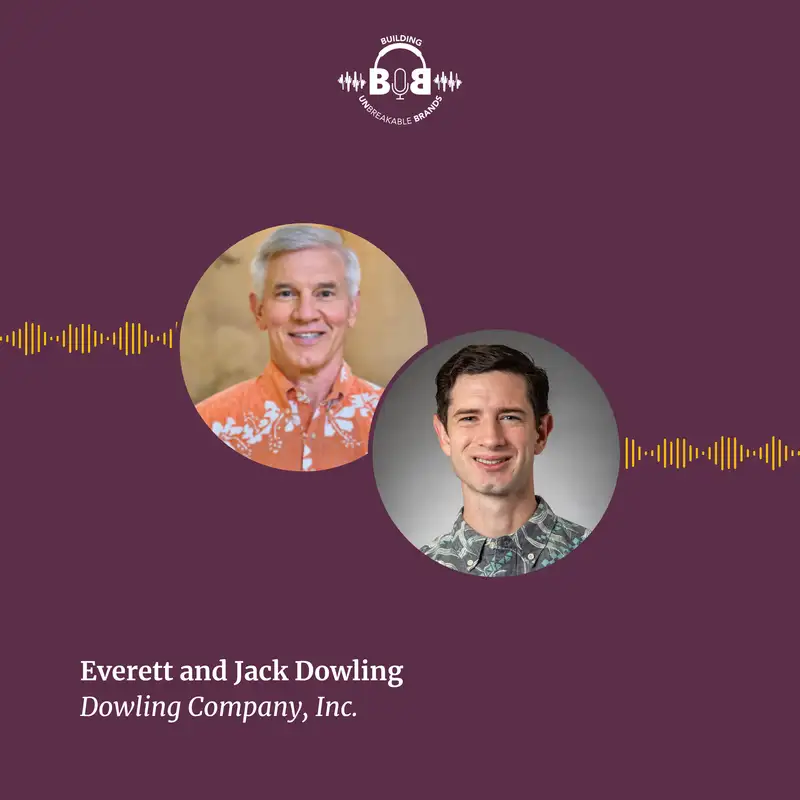
Values-Driven Succession Planning: How to Leave Something You Love with Everett and Jack Dowling
Meghan Lynch (00:00):
One of the clearest signs of a strong generational leadership is the willingness to set a boundary for themselves, especially when stepping back feels a lot harder than staying in. In today's episode, you'll hear how one family is preparing for a thoughtful succession by setting a firm date and letting everyone know about it for accountability. It's a rare blend of clarity, humility, and discipline, and just one of the many tools and guardrails they're using to ensure that they make this succession a success. You'll also get to hear the tensions they're intentionally holding and leaning into as part of the transition process and what it feels like from the perspectives of both the founding generation and the next generation. And of course, Henry joins us with his questions about how to build in a way that truly serves your neighbors. All this and more coming up on this episode of Building Unbreakable Brands.
(01:11):
Welcome to Building Unbreakable Brands, the podcast where we talk to business leaders with a generational mindset. I'm Megan Lynch. I'm an advisor to family businesses and CEO of Six Point Strategy, which helps generational brands honor their past while evolving for the future. My guests today are Everett and Jack Dowling of Dowling Company. Everett has been running his family's real estate development firm on the island of Maui in Hawaii for over 33 years. Jack serves as acquisitions director and will be succeeding his father as the second generation leader of the firm. Dowling Company focuses primarily on building residential communities ranging from affordable to luxury housing. Welcome, Everett and Jack. So excited to have you guys on the show.
Jack Dowling (01:58):
Thank you for having us. Happy to be here. Thanks for having us.
Meghan Lynch (02:01):
I'd like to start off with a little bit of history, even pre-dowling company, because I know Everett, you've shared with me in the past that part of your motivation in building the Dowling company came from seeing the impact of another family business that your family had. Can you tell us a little bit about that history and how it shaped your business for doing things a bit differently in this company?
Everett Dowling (02:26):
My grandfather started a sign company in Virginia, and that company survived for 65 years, and it was primarily electrical signs. Well, initially it was electrical signs. And then it transitioned to over the years, over the decades, to billboards. And it was a strong company. I had good market share, had a good team. Financially, it was sound. And my grandfather really, I don't think ... It was just a different generation. At that time, there weren't as many programs regarding family businesses or succession planning, and he loved what he did. He was doing it literally up until the day he got hit by a car. And when that happened, it took him out of commission for good. He was in a coma for nine months, and so he never really got around to doing any real tax planning or succession planning. Two years later, my father passed away, very young.
(03:38):
He passed away at 58, and I was already in Hawaii and created ... I call it Dowling Company version two here in Hawaii. So the family just never got around to thinking about succession, never made any tax plans. So watching that company implode not due to external factors such as market share or financial or macroeconomic issues, I really want to build something that lasts. So when Jack expressed interest in coming in the company, I was overjoyed by that and we went to work trying to figure out how to make sure what happened with the Dowling company in Virginia doesn't happen with the Dowling company in Maui.
Meghan Lynch (04:26):
Yeah. And Jack, do those stories or that experience of your family, do you see that playing out in how you guys work together now or how you're approaching the idea of succession in the future?
Jack Dowling (04:42):
Yeah. I think those experiences and that background has been pretty influential in steering the path and the different resources that we've leveraged to help really have a more structured transition process. And that's a credit to my dad and credit to the teams that we've worked with just because it helped us avoid a lot of the landmines and have some of those uncomfortable conversations as to how we transition from founder-led to the next generation and what kind of restructuring and just putting pen to paper on crystallizing some of those foundational elements that he's brought to the team that we can kind of have as a guide map for the broader team going forward.
Meghan Lynch (05:31):
I know one of the big pillars that the company both was founded on and operates on are your company values and how those show up in day-to-day culture and behaviors, and that those are kind of a part of how you guys do business. Can you talk a little bit about how the values of your company influence either how you approach operating day-to-day or how you're thinking about the future?
Jack Dowling (06:00):
Yeah. I don't know how long of a process we went through to kind of just put together the, call it 20 or so values that we really thought were representative of our team and that we want to hold ourselves accountable to. And it's ... I mean, we went through a formalized process. I'll pull it from the wall here, but it ultimately took the form of the Dowing Company way. It's this pamphlet that we have that has our 20 or so values that we think are representative of the company. And ultimately, we try to remind each team member and ourselves of these values and make sure that we're carrying ourselves day-to-day, both internally and externally with the stakeholders that we deal with in a way that is reflective and holds true to these values. So my dad does a good job. We got, "Dad, what's that board that we installed in our office?"
Everett Dowling (06:59):
It's kind of like an old 1960s airport flight display board that goes click, click, click, click, click, as the flight times change. But that message board, we put up new messages every week to focus on one of our behaviors that we want to reinforce or the company's mission. I walked by this morning and the company's mission statements up there this morning. But in addition to those behaviors that Jack referenced, we also kind of did a deep dive and a lot of discussion over a period of maybe the course of a year, just what's important to us as a family and what we as a family try to represent because I think the family values kind of drive the company values and that was a lengthy process. The group that we worked with on that interviewed Jack's fiance at the time, interviewed Jack's sister, her husband, my wife, and those were all kind of confidential conversations, but then we came together as a group and we started drafting family mission statement, family values, and that kind of teed up the discussion as a corporation and what we stand for.
Meghan Lynch (08:17):
Was there anything that surprised either of you in that family values conversation, either something that you agreed on more that you didn't expect or something that kind of emerged from that?
Jack Dowling (08:30):
Yeah. I think one of the things that surprised me, so we had those individual interviews, which none of us were privy to what any of the other interviewees said, but there was a kind of data gathering process as well where we each shared our top four values and we put it into a schedule and the consistency was really surprising and encouraging. I thought that the way we each individually viewed our family unit and some of the things that we really hold dear in terms of just the way we interact with one another and others, that there was a lot of consistency there. And I thought having that knowledge going forward and leading into this process was kind of a good centering and anchor point for us. Dad, anything you would add?
Everett Dowling (09:21):
No, it really came down to four things for us. And to remember it, I just think of hi ho. Hi, ho, hi, ho, off the work we go, but humility, integrity, hard work and opportunity.
(09:34):
So as a family, we want to conduct ourselves with humility, integrity. We want to be good role models to family members, younger family members of a hard work ethic, a strong work ethic, and create opportunities for the family. And then those values carry over to the company. And those are the things we look for when we look to add team members. We want people who are humble, who are ... And in a job sense, I think of kindness. We want to come to work, we want to work with kind people. We want to work with people who conduct themselves with integrity, who are hardworking, and try to create opportunities for themselves and for the company and for our community.
Meghan Lynch (10:26):
Well, I feel like one of the benefits of going through those kinds of values, exercises is that yes, it tells you the people and the activities and things that you want to be associated, but it also kind of provides some guardrails around what is not appropriate. What are the kinds of things that we would not do as a family or as a company? Has something like that ever come up where you guys have been able to go back to the values to be able to reassure yourselves about saying no to something or an opportunity or solve a problem that you've had to face?
Everett Dowling (11:06):
I think in terms of the projects that we want to be involved with and the people, the companies that we want to be involved with, we're careful and we want to make sure that what we do is a good thing for the, not just for the company, but a good thing for the community. So there are opportunities that we passed on that on paper prepared to be lucrative opportunities, but they just didn't feel like they were a good thing for the community. And then just in terms of kind of our employment policy and our shareholders agreement, who can own stock and what the expectations are, we do have some behavior expectations. So I mean, if there's down the road and in future generations, we hope this is not the case, but if there's ever a substance abuse issue or just a bad apple, the mechanisms or the structures in place and the mechanisms are in place to take that person out of ownership so it doesn't spill over to reflect poorly on the company.
Meghan Lynch (12:19):
I feel like those things are so huge to put in advance before you need them because there it's so much easier to kind of be clear-eyed about this is what we stand for and this is what we want in this company and so much harder to do after the fact or when you're in the midst of some kind of issue that then kind of gets clouded by either lack of communication or just family relationships and pressures and things like that. So it feels very smart to be doing these things, even though I'm sure at times it might feel like, "Oh, this is not something that we would need to worry about to be able to make those decisions now before you need them."
Everett Dowling (12:58):
And hopefully that would never come into play, but it's a good reminder for future generations to have consequences.
Meghan Lynch (13:04):
Exactly. Yeah. Jack, knowing that you've spent time away from the company, watching your dad build the company and then now are in the company, is there anything that kind of changed for you looking at it from the outside to now being inside?
Jack Dowling (13:24):
Yes. I would say I'm generally almost four years in at this point. So I transitioned back from Chicago as the last stop four years ago. And I mean, we had grown up watching my dad at work and in business, and it's been a really different and fun and informative experience being inside of the tent and seeing him and the team in action. I would say one of the big takeaways is he is at home, generally go, go, go. And that is tenfold at work. So it's a fun but exhausting process at times. But no, it's been a great experience. And I think that's one of the biggest focuses for us as part of this transition process is just by virtue of his over 30 years of doing this here on Maui, there are so many relationships and common practices and just longstanding institutional knowledge that he and a lot of the really tenured team members have.
(14:36):
And so we're kind of entering in that transition phase, not just for myself, but kind of the next generation of team members and trying to gleam and capture as much of those insights and pieces of knowledge that they each collectively bring has been a real focus for all of us over the past four years now.
Meghan Lynch (15:02):
Yeah. It can be especially hard when you have people who've been doing it so long and are passionate about, kind of like live and breathe the work that it almost becomes like second nature to them and it becomes really hard to unpack what they're doing because it's so many different considerations all happening simultaneously. So it's hard to kind of glean out like what are the different pieces of this that I need to know and learn. How have you guys been approaching that to try ... Has it just been watching, kind of observing what happens and kind of learning it yourself or have you guys taken a different approach?
Jack Dowling (15:39):
I'll tackle that one first. My dad has been very intentional about suggest, almost setting aside time from the day-to-day task and projects that we're all working on to really hone in on getting out in the community and building each of our own relationships. And so for me personally, that has taken the form of getting involved in nonprofits and local organizations and kind of peer groups. And collectively, we are all pretty busy right now. And so having that intentionality and kind of longsighted vision to understand the long-term benefits of forming those relationships today, while I can still lean on my dad and others on the team, I know that'll serve us well long-term. And so it's been a good reminder and nice to have his voice as just stressing the importance of forming those relationships today. Dad, anything you would add to that? I
Everett Dowling (16:43):
Think that was a good answer.
Meghan Lynch (16:49):
And Everett, as you kind of contemplate trying to transfer information that's living in your head or skills that you've built up over 30 plus years, just doing the work day in and day out, are there pieces of it that just feel overwhelming to pass on or do you feel like you have enough runway, enough time that it's not so overwhelming?
Everett Dowling (17:11):
Well, we gave ourselves six and a half years.
(17:13):
So we had an advisor to help us through some succession planning and the advisor recognizing how much I enjoy what I do, I think I'm here to do this. I think that's the reason I am on earth is to do what I'm doing. I think God didn't give me hand-eye coordination for a reason. He didn't want me playing golf or tennis and this is what he wants me to do. So I feel like the company's like a third child and it's really frightening when we first started this process to think about, I felt like I was putting a child up for adoption. So I think having the consultant say, Everett, you need to pick a date and you need to stick to that date. You need to communicate that date of when you're going to turn things over as frequently as possible so you don't back out.
(18:10):
You got to box yourself in. And I think that was really good advice. So when I look at the things that are most important and when I look at what I bring to the company, I think basically I'm the rainmaker for the company and to be a rainmaker, to be the one that brings in the jobs and identifies the opportunities, you have to have a network, you have to have a strong network out in the community so that you can listen and you can hear what the community's needs are and learn opportunities early, hopefully before your competitors. And I think that's, Jack mentioned that he's getting involved and that's the main focus for these next three years is helping Jack build his network in the community. And we're on the island of Maui, a lot of business decisions get made in Honolulu. So I think Jack, having grown up on Maui, he knows a lot of people here on Maui, even though he was away for 16 years.
(19:12):
He knows a lot of people in Maui and he's got a network here on Maui. So now over these next three years, the focus is helping Jack build his network on the other islands. So that's what we're going to be working on for the next three years.
Meghan Lynch (19:28):
And I would imagine too, it's not just transferring your, introducing your relationships to Jack, but more Jack, as you were saying about building that next generation of relationships of who are the people who I'm going to be doing business with for the next 30 years and starting to identify those people and cultivate those relationships, which might be different than the relationships that you have ever. Is that fair?
Jack Dowling (19:52):
Yeah, I think that
Everett Dowling (19:53):
Absolutely. Jack, you may want to share how you've gone about building your network.
Jack Dowling (20:00):
It's been a bit of a hodgepodge approach, but really trying to get out there, not just with people that we'll work with day-to-day, kind of next generation of leaders within the construction industry, within the architectural industry, those you just come across based on day-to-day functions. What we've really tried to do is gain exposure to others that perhaps are outside of the real estate or development industry that kind of are leaders in their respective fields that oftentimes to make a project move forward, you have to build coalitions and support within the community to just voice the net benefits of that project. And one of, so for example, one of the groups I recently joined a couple years ago was a group called Cayubu Kakui, and it's a local Maui based leadership development group. And what they try to do is pick, call it 10 or so individuals each year who come from agriculture or who come from the nonprofit world or first responders, the building industry.
(21:11):
And month in, month out, they will put each of us through a topic. So one month, for example, they will have planning. And the benefit of this program, in my mind, was because we each wore different hats and came from different points of view in terms of how best to move the community forward, oftentimes we would disagree with one another. And what I thought this program did a very good job of doing is developing those relationships with people who at times will likely be at odds with one another down the road during our career. And now at least we come from a place of, sure, it's okay that we have those disagreements, but we know it's coming from a place of positive intent and we have those relationships in place to lean on. So it makes it a lot harder to follow what I think is a natural tendency these days to kind of demonize the opposition that doesn't happen with this group.
(22:12):
So my dad, to his credit, suggested that cohort as one approach to kind of ingrain ourselves into the community. And there have been several others since, but it's been a really good way of developing those relationships with people that I likely wouldn't cross paths with. And if I did, it may very well be in kind of that oppositional capacity. So it's been a great way to bridge those divides.
Meghan Lynch (22:39):
Yeah. That seems like a really strategic way to grow what are truly organic relationships, right? It's still being authentic in that relationship building, but doing it in a way that might be just not the obvious people to connect with, but to cross those divides. I think that's super smart. And I would imagine too that it would help too, as you do look, knowing that one of the kind of founding values or views of the company is this kind of like building in balance of you almost need those oppositional forces to be in balance, right? You kind of need that push pull to find some of those opportunities or look at things in a really holistic way. So makes sense that you would probably seek that out. As you guys contemplate kind of like this 2028 deadline, is there anything that is particularly that either of you are looking forward to in that time?
(23:46):
Anything that's kind of like pulling you towards it in a positive way?
Jack Dowling (23:50):
I'm enjoying the time getting to work together just because there's so much growth that needs to happen, but it's also just enjoyable. We both bring very different working styles. And so it's been personally rewarding to be able to see him in action and some other team members that are soon to retire. And so I'm kind of treasuring these moments and there's a little bit of anxiety is too negative. You recognize the value that first generation leadership brings to the table and kind of the entrepreneurial experience. And so we, like my dad mentioned, we started the six and a half time horizon and he has held true to that and communicated it to the broader team, the community. But as we get closer to it, it's just a shorter and shorter duration until that transition timeline. And I'm enjoying the current time that we have on hand.
(24:49):
So yes, there are certain things that I am looking forward to. And I'm sure my dad will have his own thoughts on this, but there's also, it's bittersweet, long-winded way of saying
(25:01):
Bittersweet and I'm enjoying the moment.
Meghan Lynch (25:03):
What about for you, Everett?
Everett Dowling (25:05):
I'm enjoying watching the team become younger. Over the last couple of years, we've hired some terrific individuals who will be to Jack what some of those of us who are in our 60s who have worked together for 30 years, we're timing out and it's nice to see the team that Jack's going to be working with hopefully for the next 30 years be so competent and hardworking and just kind. They're just really nice people that are making the type of people you walk. When I come to work, I walk in the door and I'm just happy to be around these people. When you work so closely together and for so many years, it becomes an extended family and it's just, what a blessing.
Meghan Lynch (26:04):
Yeah. Yeah. It feels like there's a lesson in that of just being that thoughtful and intentional about who you surround yourself with and what a difference it makes, particularly for longevity of having relationships that you feel like, "Oh, I could spend 30 years with this person and I would be happy to do that, honored to do that. " It's a different mindset. Everett, I'm curious, as you've been working with Jack and start to see him not just as a son, but also as a colleague and as a successor, I'm curious what his kind of complimentary style ... I'm sure you guys share a lot in common, but is there any unique skills or approaches that he has that you particularly admire?
Everett Dowling (26:50):
Jack is much more analytical.
(26:53):
He's more of a deep thinker, more analytical. He's got a great work ethic, but I think the biggest difference is his analytical and deep thinking. He's light years ahead of me in both of those categories. So we have interesting dialogue. I mean, it's just a lot of times I'll be all excited about something and Jack is very skilled at tolerating my excitement and then stepping away and maybe coming back in a very, very skillful way, raising concerns about whatever it is I'm really excited about. And then we discuss it and if those concerns play out, they win the day and we don't do it. So I think he's more conservative. And I say that not in a negative way, but in a positive way. There are many things that I, many mistakes I've made over the decades that were expensive mistakes. And I think Jack is less likely to make those type of mistakes just because he's more analytical.
Meghan Lynch (28:10):
As you think about where the company was in its first 30 years and what it might need for the next 30, do you see that more analytical mind serving the next phase of the company well, or do you feel like Jack's going to need that energetic person to ping pong off of in the future?
Everett Dowling (28:33):
I think Jack, I think he will develop into that. I think Jack is energetic already, but I think his role and his training before he joined the company was kind of an analytical quantitative role and that's where his experience, and that's kind of is his comfort zone because he had been doing it for eight years for very large companies. So he has that foundation, but I think as he transitions out of that role and he shifts that to others, then that frees up his time to be more of a hunter and to go out and hunt for the opportunities. And I'm very confident that he'll be good at that. Yeah.
Meghan Lynch (29:23):
Jack, what about you?
Jack Dowling (29:25):
No, I was just going to add, I think that's one of the biggest differences and one of the things that I'm grateful for and feel like there is quite a bit of a learning curve and just hopefully by virtue of proximity and being able to be exposed to that entrepreneurial mindset, some of that wears off because like my dad said, I've always been heavy into the numbers and the quantitative side. He has always had that entrepreneurial mindset and drive. And so it's, in my mind, a really nice complimentary skillset But trying to gleam and pull as much of those entrepreneurial components that he has and the relationships and just being able to identify problems facing the community where we perhaps could be a solution partner, that has been something where I've leaned heavily on his experience and the team's experience and hope to be able to, again, by virtue of proximity and just have an exposure to that unique mindset, gain some internally as well.
Meghan Lynch (30:31):
Yeah. I think it is one of those fun things to also see how the next generation does these same functions, but just maybe in a different way or in a different approach, you can still find opportunity, but maybe approach it through more analytical means or leverage your strengths as well. So it should be fun to see that develop as you go.
(30:55):
I mean, you both have talked in different ways about this challenge or tension of loving the work, enjoying collaborating with each other, but still finding ways to both learn and also let go at the same time. I'm curious what you guys ... I mean, I know you're still in the midst of it, but what do you feel like you're learning either individually or together about what makes for a healthy succession that you wish more families might understand?
Everett Dowling (31:31):
I think talking about the tough issues, not being afraid to raise those issues out of fear that someone's going to have their feelings hurt or be angry or we're very forthright, we're respectful. Everything, we know that all of our conversations are really deep respect and love for each other. And Jack has a sister and although she does not work for the company, she's part owner of the company. And having been able to talk about the future, how do we handle that dynamic? To be able to have those conversations with her in a very open way, how do we adjust this? Jack's going to be the one losing sleep and working long hours. And how do we make it fair? Someone told me one time, equal and fear are two different things and to be fair doesn't have to be equal. So I think just being willing to listen without judging, listen to without thinking about what you're going to say, but really hearing the person has been a valuable lesson and skill that I think I've during this process have needed to work on.
(33:06):
Yeah, I think communication's key.
Meghan Lynch (33:09):
Yeah. Jack, any other lessons or things that you're kind of drawing as how you would approach or recommend other families approach succession? What's worked?
Jack Dowling (33:21):
Yeah. I think having that formalized framework to have and facilitate those kind of lines of communication and tough conversations has been important. But also we have both personally gotten a lot out of having conversations with other families facing similar dynamics and challenges and transitions and the information share and thought partnership where we can each kind of gleam best practices from their approach, what worked, what didn't, and vice versa. We've been pretty transparent with what we've been testing out. And based on that information shared, there have been some modifications made to the way we would approach things and vice versa. I know they've found some of the tactics we've used to be informative and useful. And so that network effect and being able to trade those thoughts and best practices has been a big value add for us, I think collectively as we navigate this process.
Meghan Lynch (34:23):
Yeah. I think that's huge, that peer learning, especially since succession is really something that you only get to do once, you don't get a lot of chances to mess it up and learn. So hearing from other families and sharing information I think is just a huge, huge value add, as you said.
Everett Dowling (34:40):
Well, Meghan, I hope Jack gets to do it twice.
Meghan Lynch (34:43):
That's true. That's true. He is going to get hopefully a second shot at it. So get to do it even better the next
Jack Dowling (34:50):
Time. Yeah. We have our team photos tomorrow, so it'll be hopefully three generations in there.
Meghan Lynch (34:56):
Amazing. I mean, you live on an island and particularly Maui has been through so many challenges in the past year with the fires in Lahaina. What role do you guys see your company and your team playing both in the islands healing and rebuilding and moving on from that, and then just overall and its future?
Everett Dowling (35:28):
Maui has a huge, as does most of the country, but Maui's is particularly severe housing shortage. And the environment is very important here. And there's, I think mistakenly, there has been over the last 30 years, a trend to be anti-development. And in order to be pro- environment, I think people have kind of bought in to the belief that you have to be anti-development. We believe that they can go hand in hand. You can be environmentalist and support development. You got to have housing. So we do a lot of housing. We do a lot of housing for segments of our population that are rather disadvantaged, women helping women to help to build housing for abused ladies and their children are native Hawaiians. It's ironic that native Hawaiians have the lowest percentage of home ownership of any segment of Hawaii's population, which shouldn't be the case. And yeah, right now, that's the bulk of the units we're building.
(36:48):
And we've got about, I don't know, 1,400 units in the pipeline, but of those 1,400 units, I would say over 900 are for Native Hawaiians. And it's pretty neat. When you're able to experience handing someone who's in their 90s, the keys to the first home they've ever owned. I
(37:12):
I mean, it's a chicken skin goosebump type experience. It really makes it, it drives home the message and drives home the purpose to the whole team of why we do what we do.
Meghan Lynch (37:30):
Is there anything about being a family business or a generational company that you think uniquely positions you to help be a part of some of the solutions to these problems?
Everett Dowling (37:43):
I do. I think they know they can trust us. I think it does two things. One, in terms of attracting talent, people know that there's a future. Without Jack, I don't think we would've been able to recruit some of the people that we've recruited over the last few years, but with Jack, they know that this company's going to be around for ... When Jack joined the company, I said, "Jack, you're punching your time card for 35 years, make sure you want to do it. " But they know that there's a future. And I think when we build things in the community, they know that we're not going anywhere. This is our home. We're going to stand behind what we do and we're going to do it right because our reputation is at stake. Every project, it's easy to build a reputation, but you can screw it up with one project.
Meghan Lynch (38:38):
Jack, anything you want to add to that?
Jack Dowling (38:42):
I would just add to that, that we're big believers of the idea that you are who you surround yourself with. And to add to my dad's earlier point, the team really is the driving force for us. I mean, we're blessed to work alongside them. And one of the things that I think is additive in terms of the role we could potentially play in light of the challenging times Maui faces is that pretty much everyone on our team is born and raised here in Maui and has deep, deep local ties. And so to my dad's earlier point that this is our community, this is our home, we're here for the long haul. Same holds true for everyone on the team. And so particularly as we're seeing other local families within the community struggle, we want to be a solution partner and part of the broader solution for the community.
(39:36):
And I think most people recognize that and vice versa. We recognize it with a lot of the people that we work with. And so it comes from a place of mutual trust. And I think with that in mind, everyone's kind of working towards a shared goal. And so it's been, we're early days in some of the recovery work, but I think it's been encouraging to see people approach those relationships and those projects with that mentality as opposed to kind of what existed previous to some of these crises.
Meghan Lynch (40:13):
As you guys think about the word legacy, what does legacy mean to each of you, both for the business and also for your family?
Jack Dowling (40:23):
I think it's about leaving behind something that will outlast both of us. And as I'm thinking about that, being kind of a new father, new to the community and early in my career, thinking about what I want to add to Dowling Company's legacy and what we leave behind, I think it's the way we do things, the way we approach what we do here at the company, as well as within the community. And I like to really like the expression, you kind of stand on the shoulder of giants and I feel like that's true. And I hope that over the coming 30 plus years, we're able to build on that legacy and just continue to add to those contributions, not just internally within the team, but more importantly to the community and to our home here on Maui. So that's kind of how I would ... A very unrefined way that I would think about it, Dad.
(41:33):
What do you think?
Everett Dowling (41:35):
I think it's living by those values. I think it's living by those ... I think the legacy isn't money. If the legacy isn't hard assets or buildings or whatever, I think the legacy is the values. And I think the legacy is hopefully and will be the high ho, the humility, the integrity, the hard work and opportunities that we've created for others.
Meghan Lynch (42:05):
Love it. You're listening to Building Unbreakable Brands, the podcast all about brand stewardship and crafting an enduring legacy. I'm speaking with Everett and Jack Dowling of Dowling Company, and now my son, Henry, is here to be the voice of the next generation with some questions for the Dowlings.
Henry Lynch (42:26):
Hi, Everett and Jack. Great to meet you.
Jack Dowling (42:30):
Hi, Henry. Nice to meet you.
Henry Lynch (42:32):
We were just in Maui and we loved it. What's your favorite spot or thing to do on the island?
Jack Dowling (42:39):
Dad, you take that one first.
Everett Dowling (42:43):
I like e-foiling. I like getting out in the water and getting a few feet above the water, and sometimes you're out there and you see turtles or whales, and it's nice to be in the water then look back at the beautiful mountains and beautiful Maui beaches.
Henry Lynch (43:02):
Yeah. I remember when I was there, I saw some turtles.
Everett Dowling (43:08):
Pretty neat, aren't they?
Henry Lynch (43:09):
Yeah, they're really cool. So how do you decide what kind of buildings or homes will really help the people who live on Maui, not just the people visiting?
Jack Dowling (43:23):
We do a lot of listening. I think it's a lot of community engagement and surveying and understanding where the needs are so that we can react to those needs. And right now, those needs exist across the spectrum, but where there is a particularly dire need is for workforce housing and kind of that missing middle group here on Maui so that we can keep a lot of the first responders that stepped in when we needed the most here on Island, so we can keep the people that make the fabric of our community what it is here and home. So we try to serve all areas of the spectrum, but that's one area in particular where we're hyper focused on right now.
Henry Lynch (44:06):
So how are you able to help after the wildfires in Maui?
Everett Dowling (44:15):
Initially, it was trying to help people find a place to live because so many houses were destroyed. I think there were over 4,000 buildings were destroyed, apartment buildings and single family houses. So trying to find a home for them, trying to get a ... We were able to secure a building that used to be a hotel and open that up and put a lot of people who lost their homes under a roof. And then start over time, as the months passed, start helping people rebuild their homes. One of the families that lost their homes was a house that we built 17, 18 years ago. So we're rebuilding their home now. Some of our employees lost their families and actually one employee lost her house, but other employees' family members lost their home. So trying to help them find a home and get their original home rebuilt.
Henry Lynch (45:20):
Yeah. Thanks so much. So thanks, Everett and Jack. I also have a joke for you.
Everett Dowling (45:26):
Great. Perfect.
Henry Lynch (45:28):
What's a construction worker's favorite bird?
Everett Dowling (45:33):
A woodpecker.
Henry Lynch (45:35):
The crane.
Everett Dowling (45:36):
Ah, that's a good one. That's a good one. I want to use that. Yeah. I love it.
Henry Lynch (45:43):
So thanks so much for being on the show. If people want to learn more about you or your company, what's the best way for them to do that?
Jack Dowling (45:51):
We have our website, dowlingco.com. And that has an overview on our projects, our teams, some of the initiatives that we're working on. So that would be best source of information.
Henry Lynch (46:07):
Great. We'll link to that in the show notes. Thanks again. It was great talking to you.
Jack Dowling (46:12):
Thanks, Henry. Great meeting you. You need to come back to Maui.
Meghan Lynch (46:18):
What stayed with me most today was how deliberately Everett and Jack are shaping this transition. Their approach makes it clear that succession is not a one-time event. It's a process that takes shape over years. Everett's commitment to setting a firm date to step out, especially knowing how much he loves his work, so that Jack can fully step into leadership is such a powerful example of stewardship. And Jack's reflections on honoring the entrepreneurial foundation that his dad laid while still building his own relationships and leadership style show just how strong generational continuity can be when each person brings their whole self to the work. If you'd like to learn more about the Dowling Company's projects and community impact, visit dowlingco.com. We'll link to it in the show notes. And if this conversation gave you new perspective on values, leadership or transition, please share it with another leader and don't forget to leave us a review.
(47:28):
Thanks so much for listening and we'll see you next time on Building Unbreakable Brands.