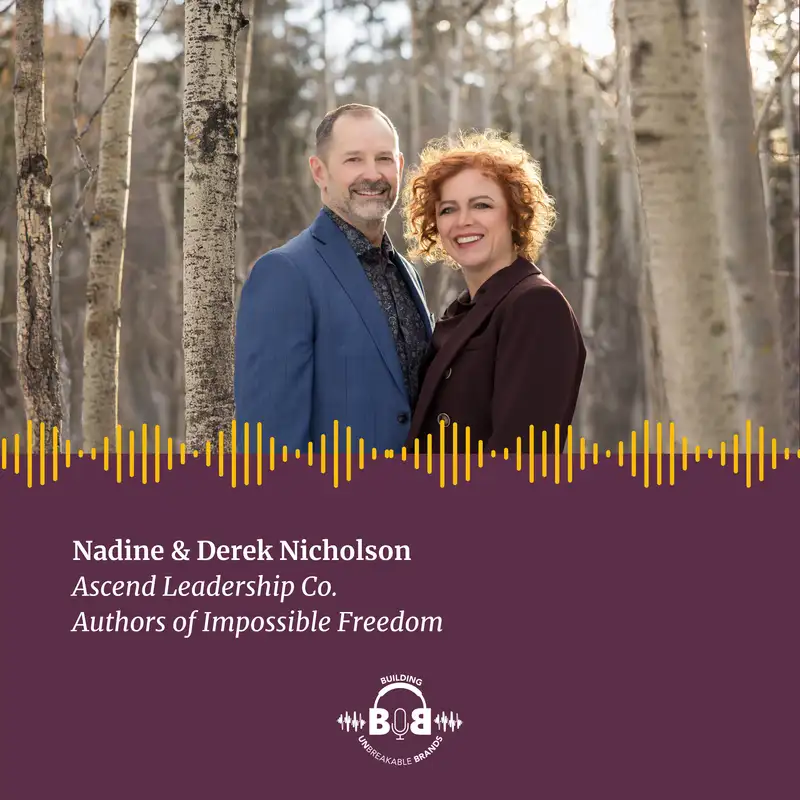
Finding Impossible Freedom in your Family Business with Nadine & Derek Nicholson
Meghan Lynch (00:00):
What I appreciated most about this conversation is the reminder that real change often starts a lot smaller and more personally than we expect. It starts with naming what's true, getting support where it's needed, and being willing to lead differently. Nadine and Derek named so many real relatable examples and practical paths to get us started. I also know that a lot of leaders truly feel like change is not possible. They feel stuck and they think that the reality that they're in is the only one. Welcome to Building Unbreakable Brands, the podcast where we talk to business leaders with a generational mindset. I'm Megan Lynch. I'm an advisor to family businesses and CEO of Six Point Strategy, which helps generational brands honor their past while evolving for the future. My guests today are Nadine and Derek Nicholson, co-founders of Ascend Leadership, an executive leadership company built to help leaders break free from the middle zone of overwork, time guilt, and decision fatigue while achieving continued business growth.
(01:19):
Together, they bring more than 60 years of combined expertise across executive coaching, business scaling, team and operations leadership, time mastery, strategic communications, and psychology. Nadine and Derek, it's such a pleasure to have you both on the show today.
Nadine Nicholson (01:37):
Thanks
Derek Nicholson (01:37):
For having us, Megan.
Nadine Nicholson (01:38):
Yeah, thanks so much for having us. We're happy to be here with you.
Meghan Lynch (01:42):
So I'd like to start from this point of view of applying your work with leaders who have built really successful businesses, but are still running themselves into the ground and talking about why that so often happens in generational and family businesses. Why do you see that being an issue with companies that have a strong foundation already?
Derek Nicholson (02:10):
I coined this term founders curse and it exists in generational businesses as well, even though maybe the business was founded by the people before you, but you grew up in the business, you saw it. And what happens is that you were there to build the processes. You did every job. You knew how every job-
Nadine Nicholson (02:31):
Or most of them were a lot of them.
Derek Nicholson (02:32):
Most of them were what you're supposed to do, how to do it as you grew up in the business, as you grew the business. And
(02:42):
One of the things that can be really hard to do is to let go of that. We find people that really all the decisions are still being held here. In fact, we had one client who had a family start a business. It was multi-generational. She's the daughter now running the business and say, "Well, it's my money, so I want to make the decisions on it. " So there's still this sense of all the decision making being made in a certain area and it makes sense. Yeah, it is your money and it's really hard to maybe let go of some of the decision making and allow and nurture people to do possibly and hopefully even better than you would or could by doing that role. So that's one of the things that really gets in the way of people being able to create freedom when there's running these businesses like this.
Meghan Lynch (03:35):
I'm hearing two things. So one is that you almost know too much about the business and how it's created, all the functions in it. So it stops you from being able to let other people into it. And then the other one sounds like almost having too much of a sense of ownership or caring too much about it so that you feel like everything is personally yours versus
Derek Nicholson (04:02):
Belonging to the
Meghan Lynch (04:04):
Business. Yeah.
Derek Nicholson (04:05):
Absolutely.
Meghan Lynch (04:06):
That makes a lot of sense. Nadine, anything that you wanted to add from your perspective?
Nadine Nicholson (04:10):
Yeah, I see often with multi-generational businesses and family businesses is that whoever's leading the company at any one time is really spearheading the culture. And so when there is a new leader, a new generation that comes in, not only does that generation change and the culture of that generation changes, that person has a different leadership approach, different leadership strengths, challenges. And so what I see is often is that whoever's leading the company, let's say it's a third generation company and let's say it's the daughter of, maybe it was the grandmother started the business, then the son took it over and now the daughter of the son, so third generation. Well, the risk is that that daughter would lead in a way that is exactly like the grandmother or exactly like the father versus leading in her own natural way while honoring the values of where the company came from.
(05:16):
And that's really the opportunity is when there's a leader who's trying to be like the previous leaders before her versus being her own natural leadership strengths, then that can create a big risk in her leadership of the company. And it's very stressful and like going up a river and fighting against the current, but really identifying what her strengths are, what her natural genius is, and leading the company in a way that is aligned with her leadership strengths and her own culture while honoring where the company came from, that's the special sauce right there.
Meghan Lynch (05:58):
So I see this so often, and particularly when leaders ... It's almost like when they get along and care too much about the previous generation, that sense of honor and respect of the past or from their parent or grandparent is so deep that it feels like the only way to honor that is to replicate it.
Henry Lynch (06:27):
And
Meghan Lynch (06:28):
That's the way that they're going to show that what they did was valuable. And that's kind of tricky. I think it's emotionally tricky to feel like you're honoring yourself at the same time as you're honoring them and kind of do both of those simultaneously. Have you guys seen that work successfully? Have you seen people navigate that tension?
Nadine Nicholson (06:51):
Great question.
Derek Nicholson (06:52):
Yeah, it is a really good question. And it starts with one of the things that we work with our clients on, and it's really about having crucial conversations or brave conversations because if you are taking something over, then being able to actually realize that you're maybe not in alignment with yourself as you're leading that company and that you'd like to do things differently, that involves actually having conversations with the people so that you can honor them and do some things the other way on that side. Then on the other side, there's also a lot more conversations to be had with the individuals in the organization as well, because you may be defining a culture shift that's going to happen in the organization, which some people who've been around there for a long time may not like, and some people who've been around there for a short time have been waiting for it forever.
(07:40):
So there's some work to be done that really involves thinking forward about what are the conversations that need to be had to be able to make this successful and be able to step into my leadership the way that I want to be leading this company, the way that I know I can take this company into future generations.
Nadine Nicholson (07:57):
And to build on that, what Derek just shared, there's some validation that happens here too. So what we really do is when we're working with one of our clients, we're really understanding, like I said in the previous, a little bit earlier in this interview, what are their natural leadership strengths and what do we want to be leveraging as their genius? And we help them see it because often what we're best at, we have a hard time seeing ourselves, right? So we help them see it, we help them give themselves permission to really own that. It comes so naturally to them that they don't even realize how amazing and how powerful it really is. And then we help them, as we help them own it, like Derek said, have those crucial, those courageous conversations about it. So one example is a company president that we've worked with and coached, and it's a multi-generational company, and the second generation leader was very autocratic in his leadership.
(09:03):
And now he's still involved, but not in the daily operations at all, more at a figurehead level, let's just say, and only really at a figurehead level for the third gen, not at a figurehead level really for the employees or the suppliers or anything like that. So now the third gen comes in and is leading the company. The company has been led by more of an autocratic kind of old school, very masculine kind of energy. Well, this third gen leader has a background in more of, let's just say it without, I want to honor confidentiality, but more of a nurturing kind of background, more of a servant leader kind of background. And she's so natural, so caring, really cares about the people and their stress levels and they're maximizing their potential and helping them feel fulfilled at work. So completely different styles. Now, her father is still involved with her to some extent, but he lets her run the company pretty much, right?
(10:09):
But there are some aspects where he's involved because he still has some oversight on the strategy and various, like the big decisions. So what we did over time is we have really helped her claim and own those strengths that she has, and we've helped her have courageous conversations with him where she's able to be herself and truly stand in her own power and her own strengths while still valuing his contributions and his influence. And so there may be a time where she may say, "Look, I need you to give me 10 minutes and really hear me out with what I'm about to say." And there's other things, other strategies that we use to help her have those creative conversations, but she's able to be heard and he's able to see that, wow, her strengths are valid and she is able to get more support from him as a primary stakeholder in the business by getting him closer and helping him understand and really communicate effectively with him as a primary stakeholder.
Meghan Lynch (11:22):
Yeah, I love that. So it's that there's a piece of really understanding the unique value that you're bringing to the company and the leadership and how that connects with future opportunities for the company. And then there's a piece of it of just that interpersonal communication of how do I make sure that I'm heard in my relationship with my father so that he feels respected and honored, but also I can still be my authentic self and have both of those still be true. Yeah.
Nadine Nicholson (11:54):
And so he also feels that the company's in good hands and that is being operated and that he can support without micromanaging in any way. So it ultimately comes down to really solid stakeholder communications. And that was my previous background before becoming an executive leadership coach.
Derek Nicholson (12:14):
We have a saying here, we say relationships first always, which means when there's a conversation to be had, have the conversation, put the relationship first. And it's amazing how they can thrive from those conversations that seemed like they were going to be really difficult that you didn't want to have. And then on the other end of it, it actually is so beneficial.
Nadine Nicholson (12:33):
And it brings the relationship closer, both from the business relationship that different generations will have with each other and ultimately the personal relationship because really we got to remember, and many people who are watching this, in this case, the person leading the company now, we're talking about her father. This is her father she's having communications with in these ways. So while he really likes to focus on business conversations, they also have a personal daughter, father relationship that they need to honor and that she wants to build because he's very deeply important to her.
Meghan Lynch (13:09):
Yeah. Derek, you said something really interesting that I just want to unpack a little bit that you're saying that you're saying is relationships first always, and that that means having the conversation. I feel like sometimes, again, particularly in generational businesses, sometimes the intention is protecting the relationship, but the solution is to not have the conversation. I'm not going to broach this because I'm trying to protect the relationship, but you're saying the opposite, that relationships first means you need to have this conversation and that that's actually what's going to protect it. Can you just say a little bit more about why leaning into that moment is so important?
Derek Nicholson (13:57):
Yeah, absolutely. Just imagine not having that conversation and then that same thing happens again and not having that conversation. And that same thing happens again. What it does is it builds resentment over time and it will actually have a negative impact on the relationship. And it may seem like on the surface where it's like, well, if I go and have that conversation, it's going to put a rift in our relationship. It's not about the topic, it's about the how of the conversation. And that's where we love working with our clients is, "Hey, let's actually not just go and knock on someone's door when you got an email from them that really kind of ticked you off and have that conversation right away." We're talking about, let's think about what we really want to know or what do we really want to be known? What's the content of the conversation?
(14:47):
Just to give a quick example, there's a difference between saying you did this wrong and saying, "This went wrong and here's the impact of it. What do we got to do to make sure that doesn't happen again?" There's ways that we want to plan around our conversation so that we can always honor the relationship and we can still actually teach, mentor, guide, lead the people that we're having these conversations with, and it's really important.
Meghan Lynch (15:14):
So just bringing some intention to the relationship when you're having the conversation.
Derek Nicholson (15:18):
Yeah, exactly. That being said, there are times, and this is the work that we do with our clients, where we dig into, is it that person or that thing that was done or that whatever that has upset you that wants you to have that conversation? We will start with, is it them or is it you? Really, they're really upset about something and I'll look at that same thing totally objectively outside of it and say, "That actually seems like a logical response that they had, so let's unpack that. " And then we'll find that out first before we decide whether that is a conversation or whether it's more a conversation. And this is also an important conversation is a conversation with yourself because that might be the conversation that needs to be had.
Meghan Lynch (16:08):
Yeah, I love it. I just want to bring it back to this time in a company and a leader's life where they're just stuck. They've kind of built the success, but then they're stuck in the day-to-day, they feel overworked and overburdened by the business and that there's not rumor energy for the business or the leader to grow. Can you talk a little bit more about what exactly the middle zone looks and feels like? How would we know if we're in that middle zone versus just kind of burned out or tired?
Nadine Nicholson (16:51):
Well, we might as well mention this now. We actually have a quiz that will help you determine where you are and whether or not you're in the middle zone. And it only takes five minutes to do and we encourage you to do it. So maybe by the end of this podcast, we can give that link.
Meghan Lynch (17:07):
Yeah,
Nadine Nicholson (17:07):
Definitely.
Meghan Lynch (17:08):
Yeah. We can link to it in the show notes as well.
Nadine Nicholson (17:10):
Yeah. So essentially a leader is in, think of it like climbing a mountain. Think of growing a business like climbing a mountain. Derek and I live in the Canadian Rocky Mountains and we're in Calgary, Alberta, Canada. For any of you who know Banford, like Louise, we're really close to there. So we do a lot of hiking. I'm a hiking guide also. And when you're climbing a mountain, you get to this point where you've come so far and let's say halfway to this plateau, and then you look down and you think, wow, look how far I've come. It's a sign of success, right? How far you come. And then you look up and you think, I can't keep going the way that got me here. If I keep going the way that got me here, I'm not going to make it. It's unsustainable. I'm exhausted and I can't keep going this way.
(18:09):
But the thing is, is that person only knows one way to hike. They only know that what got them to the middle zone. And if they keep using that same way of leading their business and their life, they're absolutely going to burn out. It's unsustainable. What got them there can't get them to what we call impossible freedom. Impossible freedom is what we call the summit. It is the freedom that most entrepreneurs, multi-generational businesses, founders believe is completely impossible. We here make it possible. And that freedom is essentially the definition is feeling lit up and alive while driving more financial growth at the same time, because most entrepreneurs think they have to sacrifice one for the other. Either I'm going to have a wonderful free life and feel all good about myself, but I won't make any money or I have to give up my business altogether, sell it or close it, or I'm going to make all this money and I'm going to be miserable and I won't have a life.
(19:16):
So what we do is we help that leader, that owner take back their time, be lit up and inspired, and actually drive more revenue because of it.
Meghan Lynch (19:26):
And I think here too, again, to just bring it back to the generational piece, oftentimes what was modeled to us was that burnout, somebody, mom or dad working 80 hours a week and never taking a vacation and working on vacation and
Nadine Nicholson (19:45):
Not
Meghan Lynch (19:45):
Being around for dinner and always talking business and not having that balance or any kind of freedom in their life. And so I think it does become really hard to picture another way and still think that we could have the same level or a higher level of financial or business success for the next
Nadine Nicholson (20:10):
Generation
Meghan Lynch (20:10):
To make sure that this business continues to grow and thrive. So is there a piece that kind of helps get people a first step that people take to start to break some of those mental models?
Nadine Nicholson (20:23):
Yeah. I mean, it makes sense that it feels impossible. Let's really normalize this as you just did, right? Because you, we, both of us, we learned those patterns. We learn those behaviors from our parents too. My dad died pretty young and Derek's dad died at work. So what we've learned in this generation in, let's say our generation being maybe leaders who are leading companies, maybe we're in our 40s, 50s, 60s, that kind of generation at least, is that we've learned to suffer. We've learned to kill ourselves and sacrifice ourselves in order to make money. And that's the bottom line. And well, okay, do we want to kill ourselves earlier than we will have to pass away? Why would we do that art to ourselves? Why would we end our lives sooner? So the first, when we think about some steps, I guess, to take is that I would really encourage business, I would just say it this way, we know that this is a paradigm shift.
(21:29):
We know this is radical. Being lit up and alive or just feeling inspired and feeling like you are able to do what you love to do every day and not be exhausted and depleted every day. It's not a reward for your success. It's not like you have all this success and one day you're going to be happy because that never comes. What we're saying is it's the way to achieve it. So I'll give you a very simple example. Let's say that someone's listening here, there's something that gives you a lot of joy. It makes you feel inspired. It actually makes the whole day better because of it. But let's say you always say, "Once I get through my list, once I get through this, then I will give myself that. " Well, what happens? That never comes. A very concrete example is one of our clients, she has some hiking trails in her backyard.
(22:29):
And when she goes for a walk first thing in the morning before she goes into the office, 30, 40 minutes max, she is more clear. She's already solved many things. She is grounded. She is energized. She has gotten her feet on the ground. She has tapped into her clarity and her confidence, right? The whole day goes better because of it. But when she doesn't do that, she's discombobulated, she's not grounded, she's not clear, she's scattered. So she may make up in her mind, "When I get done my list, then I'll go for that walk." But it's that walk. It's her number one business strategy to do the very thing that she had been putting off till the end of the day. It's her number one business strategy to do it first, and everything else is more effective and successful because of it. So that would be my tip as one step that you could take would be to think about what is the thing that you put off that gives you the most joy that you think is a luxury?
(23:37):
Consider putting it at the center of your calendar and designing everything around it so that you always get to do that thing.
Meghan Lynch (23:45):
I love that. And I'm sure everybody listening has that thing in the back of their mind going, "Oh yeah. All right. What would it be like to do that? " Knowing that you kind of call it that impossible freedom, do people have to believe that it's possible before they're starting to work towards it? Or do you work with people who are constantly telling you, "I can not get there."
Nadine Nicholson (24:10):
That's a great question. I would say that they need to believe us. They need to borrow our belief that it's possible. And we work together to understand what is their wake-up call? Why would they change doing anything that they're doing? Because there's got to be a case for change. Change management requires us to know why would we change anything at all? What's in it for them? Why bother? Once we know that why, then we co-create, we help them design that vision of what impossible freedom looks like to them. What impossible freedom looks like to you, Megan, what it looks like to us, what it looks like to Beth, to Bob, I'm just making up names, is very unique to each person. So we help them get clear about what it is for them, and then we help them to, first of all, borrow our belief that together we can help them create it, and we walk them through a process, through our methodology to help them achieve it.
(25:15):
Now, it really helps when someone does say, "You know what? I don't know how we're going to get there. That's why I'm hiring you guys to walk me on that path, but I believe you and I believe that we're going to do this. " Just to say, "I believe we're going to do this. I don't know how to get there, but I trust you and I trust that you're going to show me how." And sometimes there's people who really want it and they really want to believe it, but they're skeptical. And so what we say to them is we say, "You know what? Again, borrow our belief and we're going to take you one step at a time. Six months in, we're going to take stock of your results and how far you've come." And at that point, then they really realize, "Wow, I had no idea that we could do this.
(26:05):
I'm actually seeing this. Now I get this. "
Derek Nicholson (26:07):
So over time we can build belief, but we do start foundationally with a desire because people do really need to have a desire for something different. You may not believe you can get there, you may not believe you can have it, but if you have the desire, it's a place to start and build from, and then we can show you what you can do and then you'll start believing more.
Nadine Nicholson (26:31):
Yeah.
Meghan Lynch (26:31):
Megan, we have- Borrowing your belief is good. Yeah.
Nadine Nicholson (26:34):
We had one client who just said to us, because we just finished, we worked together for a year and then we had a conversation about all of her results and her ROI and everything she transformed. And she said, "I got to tell you, when we first started working together, you encouraged me to borrow your belief, but the best I could do at the time was suspend my disbelief." So she said, "I suspended my disbelief and I'm amazed with really truly that we actually got there together."
Meghan Lynch (27:11):
That's cool. Yeah. So sometimes it's just, even if I can't quite believe, maybe I cannot be so disbelieving to
Nadine Nicholson (27:18):
Start. Yeah.
Meghan Lynch (27:19):
One of the pieces of your framework that I really love and that you talk about a lot is the say do gap. And I feel like that one is just incredibly relevant to family businesses where there is a lot of good intention. They're often just, again, very thoughtful about relationships, very intentional about how they want to do business and the values that they're bringing, but the follow through often gets derailed and that's kind of where things start to fall apart. I was hoping that you could talk a little bit about the say do gap, talk about it for the audience and what families can do to close that with themselves and their teams.
Derek Nicholson (28:03):
The say to gaps are everywhere. It's interesting. Any place that you find yourself maybe a little disappointed or maybe even as high as resentment or something happening, it's because there's a gap. There's a gap in really, if you were to say it out loud, what you want to see, what do you want to see happen, what do you want to see in front of you, and then what's really happening. And it's one of the key places that we look for everything. It causes so much resentment in businesses and entrepreneurs, founders, leaders everywhere. And the thing is, it's not just them. We also know that from tons of research that employee engagement across organizations, one of the biggest things that impacts employee engagement to the negative going down is leadership integrity and their say-do gaps. And it's something that is so important, it's critical to really identify what are those ones that we need to work with, dissolve to get some momentum moving forward for both the leader and for the company.
Nadine Nicholson (29:03):
Yeah. So I love that this is we're having this conversation about family businesses because the person who's leading the company is not waking up in the morning to say, "I'm going to be in a say-do gap today." It's not intentional, but it's slippery. So a very good concrete example is a company we're working with or actually worked with in the past. This is a former client of ours. And the two founders are a husband and wife, husband and wife, they're the founders. They have one of their children involved in the company, and now there's a third generation grandchild. So the grandchild isn't working in the company, but could one day. And I asked back then, I asked, as we're designing their time and their team, I said, "When do you have collaboration meetings? With the two of you and your child, when do you have those executive leadership kind of collaboration meetings?
(30:09):
And this person, one in the partnership said on Saturdays. And I said, how is that working for your child who has the baby? Well, actually it's not working great because our child actually wants to focus on family time on the weekend. So you can see an example where the two founders were having business conversations on the weekend when their son was wanting to spend time with their baby. So that is a save you gap where the two founders really actually want to have family time on the weekend. They don't want to be working on the weekend, but they're doing it because they think that they have to because that's the only option there is. So what we do is we identify that's a boundary and we're going to design the work time into work time so that they can have clear boundaries of what is business relationships and what are personal family relationships and when do those happen in their calendars.
Meghan Lynch (31:15):
Yeah. And I think it's also one where it's probably also another gap that the next gen is feeling of like, you say you want me engaged in this business and that you want us to work together, but you're basically forcing me to choose between my baby and the business. It doesn't feel like you're really inviting me into this or providing something that feels doable for me and my family. And again, I think it's not a deliberate-
Nadine Nicholson (31:47):
No, it's not deliberate. Deliberate.
Meghan Lynch (31:49):
But it does have those ripple effects that can really break down relationships over time and just, as you said, frustration or disengagement and can totally see it. I feel like my son is one of my best say-do gap spotters. He'll be like, "Mom, you always say I can do this tomorrow, but then we never actually do it. Or you say that you're going to stop work after an hour and it's been an hour and a half." And so he's very good at that accountability to make me go, "Oh, right. Yes, I need to be more cognizant of those gaps and to not have him have that picture of me of somebody who says one thing and does another." Because I think it does ... Again, most generational businesses really pride themselves on integrity and there's nothing worse than feeling like, "Oh, I'm not having integrity around this.
(32:45):
"That doesn't feel great. And I think not only breaks down trust with other people, but it's very demotivating to yourself when you feel like you're-
Nadine Nicholson (32:53):
Absolutely. You just read my mind. It erodes self-trust. And ultimately, self-trust is the most important leadership strength that we could really hone in leaders to trust themselves to do what they say they're going to do and to be in integrity with themselves. And that creates trust in all of their relationships because of it.
Meghan Lynch (33:16):
Love it. A second piece that you talk about is the support gap. So we've got the say-do gap, and then we also have the support gap. And I think, again, a lot of family businesses struggle with this sense of control. I want control and I don't want to give up control. I really care about this company. I feel a strong sense of ownership of it. And also, I want other people ... I'll hear them say, "I want other people to act like owners or to have ownership," or, "I want people to take ownership of blah, blah, blah," or, "Help me do this thing." How do you help clients build that real support in their teams and around themselves without losing that control and sense of identity around the business?
Nadine Nicholson (34:07):
It's a great
Derek Nicholson (34:08):
Question. Yeah, it's a great question. The support gap itself is usually made up of three different areas that we'll look at with people in their companies. One of them can be with skill fragmentation. They might have the wrong people and the wrong jobs. There might be some people with amazing skills that we don't even know that they have those skills because their role is prescribed by the title of the job and the job description that was sent out by the company when they first did it versus really what is the work that we need to get done and accomplish. So it's one of the places that we look is around that. The other place we look is we look at how people function with each other at work. We look at, do they function as a team? Do people understand what the goals are as a company?
(34:53):
Do people connect what they do as impacting those goals? Do they have purpose? So we'll look at that as well. The last thing we'll look at is leadership. One of the bigger things that we see is that leaders across the company, so it could be all the managers in the entire company that this founder has are not really leading their people. They're not taking care of those other two leagues. They're just kind of hiring people into jobs and letting them do the job. So it's important that leaders understand that leadership is part of your job description as a leader. So to dedicate the time, because often people are spending all their time in operational decisions or things that are more operational and less in leading. So we'll look at, okay, well, what is the leadership culture and what is happening with leadership across that company to get the outcomes that we want?
(35:50):
And so we'll look at these and we'll be able to take those so that it allows those founders to still be connected to the purpose, to the decision making, to everything and design really are two words that we use a lot are intentional design, whether it's around your time or whether it's around your team, but to actually design what are the outcomes you want and what are the pieces that need to be put in place to actually get to where you want to get to, because oftentimes it's just evolved versus been designed.
Meghan Lynch (36:20):
Yeah. I feel like one of the two themes that I'm seeing a lot, both in our conversation today and also in other conversations I'm having is a dual theme of one, identity, kind of like, who am I? How am I leading? Who are we together? What are we trying to do? And then also that intention piece of how is everything that we're doing crafted around that. And so I'm hearing you bring up those two themes throughout a lot of what we're talking about. I'm curious in your experience, and again, maybe you have a story to bring or an example of what shifts when either a founder or a next generation CEO finally builds the space that they need to lead differently in this way. How does the business change? How does the family change? How do relationships change? What's going on?
Nadine Nicholson (37:16):
Oh, that's a big question. That's a good question. Do you want to start? No,
Derek Nicholson (37:21):
You go ahead.
Nadine Nicholson (37:22):
I mean, everything changes. When we first start working with a client, they're in time guilt. They're experiencing time guilt where they just feel like they can't ... Whether they're with their family, they should be working. And when they're working, they should be with their family and they just feel guilt about their time. They're overthinking, they're overanalyzing, spending way, way too much time overthinking things and stuck in fear and making fear-based decisions often. And then they're also overworking and working more than they need to because they're so exhausted and they can't make clear decisions because they're overthinking, because they're tired, because they're feeling guilt. So I mean, so much transforms when we first get them in a place where they actually feel more rested and rejuvenated and more clear thinking and making decisions much more quickly from more self-trust and clarity within that we're capturing all of this time and energy that is leaking and that they're losing.
(38:43):
So as we capture that, and they're actually more clear and more confident and making faster decisions that are from self-trust and not fear, then their relationships improve, their health improves, they're happier and not resenting their business anymore, or they're resenting just feeling resentment overall. They're happier. They actually realize that they're starting to love what they do because they're doing more of what they love and their revenue grows because of all of those factors.
Derek Nicholson (39:28):
Yeah. We've also had some of our clients, just from a client's story, it's really cool that we've had some of our clients who actually come back to us and tell us a story that they experienced where people in their lives have come and given them unsolicited feedback going, "What are you doing? Because you're showing up differently and whatever you're doing, keep doing it.
Nadine Nicholson (39:49):
"
Derek Nicholson (39:49):
And that's really some of the best things
Nadine Nicholson (39:52):
That
Derek Nicholson (39:52):
We can see, some of the best feedback that we can capture because that positive reinforcement just has people want to keep
Nadine Nicholson (40:01):
Doing
Derek Nicholson (40:01):
These things, keep making the shifts.
Nadine Nicholson (40:03):
I'm laughing because this is actually kind of a good story to build on that, is that we had this one client in a family multi-generational business, third generation leader, and there were some key market changes that were politically related with political changes, and she was really needing to look at, really looking at costs and looking at every nook and cranny. And we worked with her for a full year of coaching, and then she was evaluating whether or not she was going to be able to invest in a second year of working with us. And she was really questioning it. Even though she was getting such return on investment and absolutely wanted to continue, she was looking at every opportunity to save money. And her finance director said to her, when this person went to the finance director to discuss it, the finance director said, "You can't stop that.
(40:59):
You can't stop that coaching with the dean of here." I already
Derek Nicholson (41:01):
Went in the budget.
Nadine Nicholson (41:03):
We need to get that and make sure that that continues. So that's a great story when the finance director who's managing the budget and all that- Even the
Meghan Lynch (41:13):
First time
Nadine Nicholson (41:13):
Ever
Meghan Lynch (41:13):
That a finance director has prioritized coaching.
Derek Nicholson (41:18):
Yeah, exactly.
Nadine Nicholson (41:19):
And said to this person, "You've got to keep doing this.
Meghan Lynch (41:22):
"
Nadine Nicholson (41:22):
And she did.
Meghan Lynch (41:23):
Yeah. It's huge. I think the other thing that that speaks to is the ripple effects, all those unintended consequences that we have on the people around us that positive or negative, they are happening. And it sounds like that's one of the outcomes is having that positive ripple effect instead of having that negative ripple effect on everyone else around you. So the fact that other people are saying like, "Oh no, the way you show up is making things better for me or for the team or for the company or for my family, you need to keep doing that. " That's huge. That's huge because I think that again, when particularly I think for generational leaders, impact is one of the key things that they want to have as a positive impact on the community, the team, the world. And so this idea that it starts with us, right?
(42:27):
That's how that impact starts is being able to be strong ourselves and clear and empowering for other people. And that's a big piece of how that gets lived out.
Derek Nicholson (42:38):
Yeah. If one of the reasons that Nadine and I have talked about this often too, it's one of the reasons why I love doing work in organizations that are larger and a little bit more complex. Would I love to work with all 500 people in a company? Absolutely. Can I knew no way because then I've lost my balance. So that's not going to happen. But if I'm working with the right people, could I possibly make an impact on all 500 people through a company if we do the right things? Yeah, I can. And that's important because really if you can get all 500 people in that 500 person company coming to work every day, like the Seven Dwarfs singing on their way to work jazz to get as much done as they can, then that's so worthwhile.
Meghan Lynch (43:23):
Yeah. Yeah. And you think of what that effect has on their family life- Their family debt. And then their kids and the patterns that they're setting up for their next generation. So I think I love that you're thinking about it that way, even from your own coaching work, that it's the way that you can have the biggest impact is to work with the leaders that are going to have those ripple effects.
Nadine Nicholson (43:46):
Yeah, totally. And then to build on that idea and what you said earlier is I'll say, and maybe the people who are watching this, you can really resonate, relate to this, is that when you're in a family business and multi-generations as well, is that there are certain things that you really need to discuss and make decisions on that cause you to feel really lonely because it's lonely in your role often because there's certain things that you need help with that you actually really don't want to be discussing with some of your leaders. You need some confidentiality, you need some objectivity. And so that's a key role that we play for our clients is that we're objective, we are focused on the business goals, on their goals, on their agenda, and we're able to help them navigate very sticky and difficult issues and challenges like challenges with their siblings, like challenges with various employees or challenges with the generation before them, like very difficult things where we're not personally ... We can be objective and really support them to navigate through those things so that they have a confidential and objective sounding board to make clear and fast decisions that they can feel good about.
Meghan Lynch (45:11):
You're listening to Building Unbreakable Brands, the podcast all about brand stewardship and crafting an enduring legacy. I'm speaking with Nadine and Derek Nicholson of Ascend Leadership, and now my son, Henry, is here to be the voice of the next generation with some questions for the Nicholsons. Take it away, Henry.
Nadine Nicholson (45:32):
Uh-oh, I think I'm getting hot here. I'm sweating. I get nervous. Yeah. Hey, Henry. Great to see you.
Henry Lynch (45:38):
Hi, Nadine and Derek. Great to meet you. You too. So I have school, piano, basketball, drama club, and I just added guitar lessons today. So what's your advice for someone who's interested in a lot of things, but still wants time to relax and hang out with friends?
Nadine Nicholson (46:01):
Great question. My advice would be to really look at what of all those things really give you the most joy and the most personal, really make you feel good. You really love doing those things and making sure that you have, I would say, at least three of those things that give you joy and that you really love. Make sure that they're a priority in your schedule so that they don't get compromised or dropped in any way. And that will really help you be more energized and feel better in all the other things that you're doing.
Derek Nicholson (46:40):
My little piece of advice with that is to make choices without guilt based on what you want. So if, for example, you have a basketball game and drama class at the same time on the same day, make a choice, choose which one really is going to make you the happiest that day, let go of the other one that day without feeling guilty that you didn't go and own that choice.
Henry Lynch (47:07):
So there are sometimes when my brain just feels overwhelmed and overloaded, and I just kind of want to zone out. So what do you tell adults that feel that way?
Nadine Nicholson (47:24):
Yeah, it's what does zoning out look like for you? We want to look at, sometimes adults will use zoning out methods or practices that are not healthy for them, and kids do as well. So for example, with adults, sometimes they zone out, sometimes they drink too much wine, or they watch-
Derek Nicholson (47:47):
Sometimes they sit on social media for too much.
Nadine Nicholson (47:49):
Yeah. Or they watch ... Yeah, they watch
Derek Nicholson (47:52):
Netflix.
Nadine Nicholson (47:52):
Watch Netflix too much, or they're not getting to bed, they're not getting sleep. So what we do is we just really help you just understand what are ways that you can zone out that are actually healthy to you? For example, for some adults, it might be like getting into nature and going for a walk outside and getting some fresh air. Turning off the technology is often healthier than scrolling. So for kids, I would say, what are some healthy ways that you can zone out that don't actually make you more exhausted and depleted, but actually help give you some joy and make you feel like, "Hey, I actually really love doing those and I feel better about myself and healthier when I'm doing those things."
Derek Nicholson (48:37):
And I can add on a piece as well, Henry, that can be helpful. And it's like a little formula that I've used in the past and it's like overwhelm comes from trying to be everything to everybody. It's just doing too much. And there's one cure for feeling overwhelmed. And when you want to zone out, it's usually because there's a sense of overwhelm, like there's just too much, so then I just stop it all. And the cure for being overwhelmed is choice, comes back to choice. It's really looking at what are the choices that I have in front of me and then making those choices that you otherwise may not make. So for example, you may be doing 10 things, but two of those things you're doing because you think someone else wants you to be doing them, but you don't really know whether they actually want you to, but you don't want to do them.
(49:26):
Then the question is, do you still do them or do we talk to that person and say, "We're not going to do this anymore because it's overwhelmingly."
Henry Lynch (49:35):
Yeah. So have you ever helped someone who loves their work too much and can't stop?
Derek Nicholson (49:43):
Totally.
Nadine Nicholson (49:44):
All the time, every day.
Derek Nicholson (49:46):
Yep. That's a really great question. And there are some people who love their work so much, they don't stop. They want to work 60, 70 hours a week. And when we work with our clients, we'll determine whether that is one of those things. That could be their genius, that could be what gives them energy, it could be a choice that they're specifically making and that there is nothing that they feel regret for that. And if so, then we design them a 70-hour work week so that they can have that because there may be some people that want that. There may be some people that are the opposite that just want to work a 40-hour or a 20 or 30-hour work week and experience a lot of other things like becoming a professional hiking guide or kayaking down the Colorado River through the Grand Canyon on an adventure.
(50:37):
We will then help them to design that. So yes, we have experienced people who just want to work and do a ton, and we just make sure that along the way that we still, again, make the choices to choose that work without regret versus choosing that work, thinking we're supposed to choose that work and not the other thing.
Henry Lynch (51:01):
All right. And then I have a joke for you.
Nadine Nicholson (51:05):
Awesome.
Henry Lynch (51:06):
So my teacher told me I'd never be successful because I procrastinate too much. So I told her, "Just you
Derek Nicholson (51:17):
Wait." I like it. That's awesome. That's awesome. Hey, that brings up a little point that I'd love to share too, is procrastination's not always bad. Everybody tells us procrastination's bad. Sometimes we procrastinate on things because they really don't matter that much and we procrastinate on them versus if we just say, "Hey, that doesn't matter and I'm just not going to do that, " then we don't have to procrastinate anymore. So it can be a sign to look at those things and see whether they really matter.
Nadine Nicholson (51:47):
And sometimes we procrastinate because that thing we're procrastinating about feels really hard and it feels really uncomfortable and it's like that thing is really difficult. And so we procrastinate because, well, what do we typically do? Are we going to spend more time on what feels hard or what makes us feel like it's hard and it's difficult that makes us feel bad about ourselves or are we going to spend more time on what feels easier and what makes us feel good about ourselves? It's a natural human thing. And so if you find that you're procrastinating on something that you know you need to do, but maybe it's just feeling hard and it's like stirring up, maybe you just don't know how to do it or you're scared about it, then I would get some help. I'd say to your mom, for example, "Hey, you know what, mom, I know I need to do this thing and I'm noticing I'm delaying it.
(52:41):
I said I was going to do it yesterday and I didn't. I said I was going to do it today and I didn't. I think I need some help." And just so ask for some help.
Derek Nicholson (52:50):
Yeah. So for anyone procrastinating, look at, it could be that you just need help to get started.
Nadine Nicholson (52:55):
And some support.
Henry Lynch (52:57):
Thanks so much for being on the show. If people want to learn more about you or your company, what's the best way for them to do that?
Nadine Nicholson (53:05):
I would say go to our website to that quiz I mentioned earlier. It's ascendleadership.com. So A- S-C-E-N-D, so like ascendriseleadership.com/quiz. And this quiz takes five minutes. You get a practical results that gives you practical tips and suggestions. And also it gives you an opportunity to say, "Hey, if you want to have a 30-minute coffee date with us virtually, you can just reach out to us anytime by email and we'd love to have that with you.
Derek Nicholson (53:39):
"
Henry Lynch (53:40):
Absolutely. Great. We'll link to that in the show notes. Thanks again. It was great talking to you.
Nadine Nicholson (53:46):
Thank
Derek Nicholson (53:46):
You. Thank you, Henry and Megan for having us.
Nadine Nicholson (53:49):
Thanks
Meghan Lynch (53:49):
So much.
Nadine Nicholson (53:50):
That was super fun.
Meghan Lynch (53:54):
What I appreciated most about this conversation is the reminder that real change often starts smaller and a lot more personally than we expect. Nadine and Derek named so many real relatable examples and practical paths to get us started. I also know that a lot of leaders truly feel like change in their day-to-day reality is not possible. For those of you listening who feel that way, consider Nadine's idea of borrowing someone else's belief. Maybe you don't have to believe it yourself, you just need someone to believe in you. And in a family business, that kind of shift can ripple far beyond the individual leader. It can change the culture of a business and the experience of the family around it, which truly is the work of every generational leader. If this podcast resonated with you, please consider sharing it or leaving a review. It helps other people find us.
(54:59):
Thanks so much for listening and we'll see you next time on Building Unbreakable brands.